
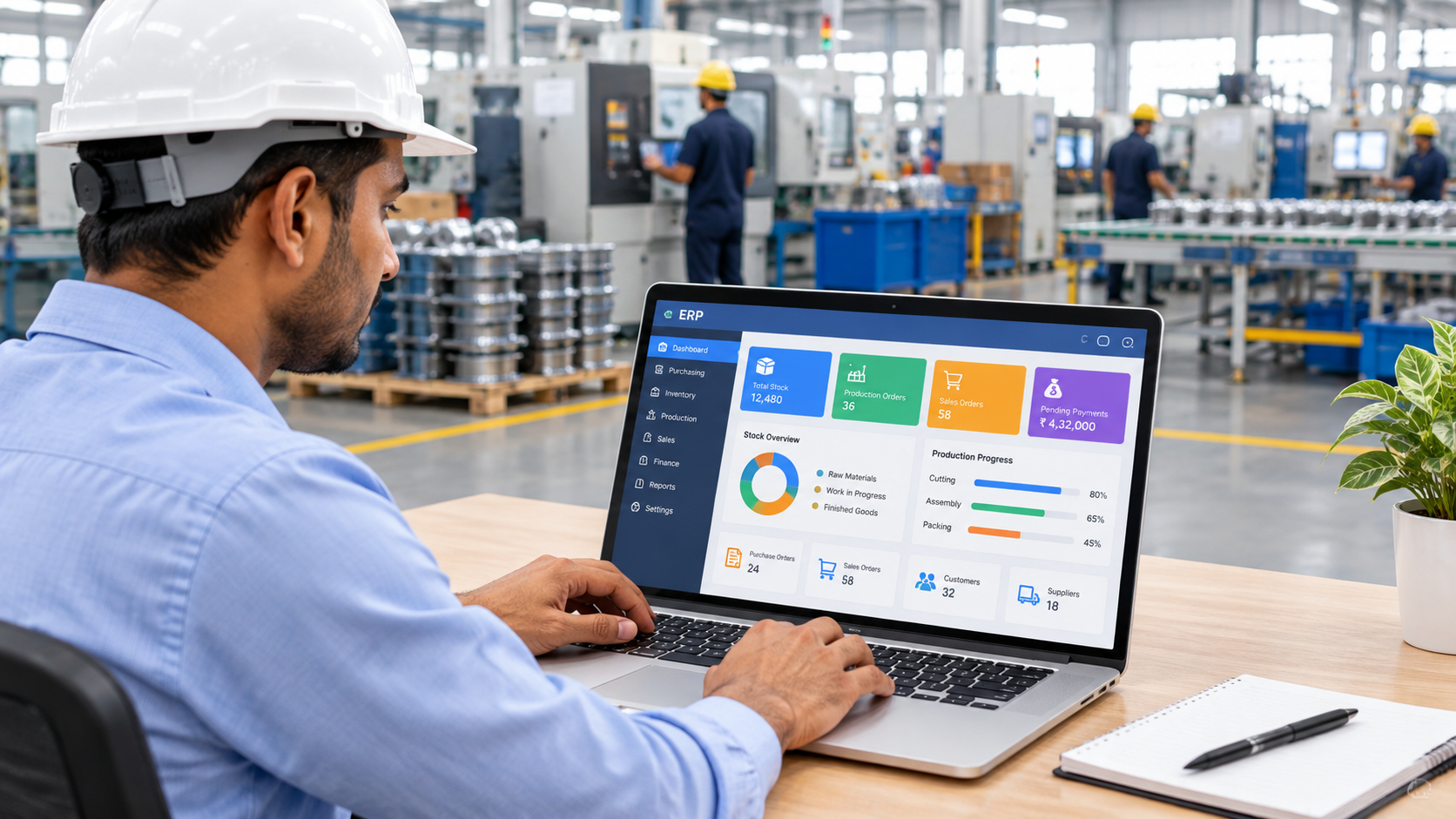
How ERP Software Helps Manufacturing Businesses Reduce Costs and Improve Productivity
Manufacturing businesses manage several interconnected activities every day, including purchasing raw materials, maintaining inventory, planning production, managing employees, processing customer orders, and preparing financial reports. When these activities are handled using separate spreadsheets, registers, and disconnected software, it becomes difficult to maintain accuracy and control costs.
This is where Enterprise Resource Planning (ERP) software can make a significant difference.
ERP software brings important business processes together in one integrated system, helping manufacturers access reliable information, coordinate departments, and make better decisions.
What Is ERP Software?
ERP software is a business management solution that integrates different operational functions into a common platform. Instead of maintaining separate records for purchasing, inventory, production, sales, and accounting, businesses can manage these processes through a connected system.
For example, when a sales order is confirmed, the system can help the team:
- Check stock availability.
- Identify raw material requirements.
- Plan production schedules.
- Coordinate purchasing and manufacturing.
- Track order fulfilment and delivery.
The exact capabilities depend on the ERP solution and the modules implemented.
1. Improve Inventory Management
Inventory management is one of the most important responsibilities in manufacturing. Excess stock increases storage costs and blocks working capital, while insufficient stock can delay production and customer deliveries.
An ERP system can help businesses:
- Monitor raw materials, work-in-progress, and finished goods.
- Track stock receipts, issues, transfers, and adjustments.
- Set minimum stock levels and reorder alerts.
- Maintain supplier and purchase records.
- Identify slow-moving and excess inventory.
With more accurate stock information, managers can make purchasing decisions based on actual requirements rather than assumptions.
2. Plan Production More Effectively
Production planning involves coordinating materials, machinery, employees, and delivery schedules.
An ERP solution can support production planning by connecting customer orders with material availability and production requirements. Managers can track work orders, monitor production progress, and identify delays earlier.
Key benefits include:
- Planning production based on customer demand.
- Checking material availability before scheduling work.
- Tracking work orders and production progress.
- Identifying production bottlenecks and delays.
- Improving coordination between purchasing and production teams.
For example, if an order requires materials that are unavailable, the team can identify the shortage before production is scheduled. This helps reduce avoidable interruptions and improves coordination between departments.
3. Reduce Manual Data Entry and Errors
When departments maintain separate records, the same information may be entered multiple times. This can lead to incorrect quantities, inconsistent customer details, billing errors, and outdated reports.
An integrated ERP system can help businesses:
- Maintain shared business information.
- Reduce repetitive data entry.
- Improve consistency across departments.
- Minimize errors caused by disconnected records.
- Make updated information available to authorized users.
Automation does not eliminate every error, but it can reduce manual effort and improve consistency when processes are configured correctly.
4. Manage Purchasing and Suppliers
Purchasing decisions directly affect production costs and material availability.
ERP software can help businesses:
- Maintain supplier information and purchase history.
- Prepare and manage purchase orders.
- Record incoming materials and goods receipts.
- Track pending purchase orders.
- Compare supplier prices and purchasing records.
- Review supplier performance and procurement requirements.
By keeping purchasing information organized, management can evaluate suppliers, review purchase history, and identify opportunities to improve procurement planning.
5. Gain Better Control Over Costs and Profitability
Manufacturing costs may include raw materials, labour, production overheads, packaging, transportation, and other operating expenses.
An ERP system can help businesses:
- Consolidate relevant production cost information.
- Review raw material and labour expenses.
- Monitor operating expenses.
- Analyse production costs and sales margins.
- Support budgeting and pricing decisions.
- Identify areas where costs may be increasing.
When configured with suitable costing methods and accurate data, ERP reports can help management understand where costs are increasing and make better financial decisions.
6. Generate Reports for Faster Decisions
Business owners and managers need timely information to understand how their operations are performing.
Depending on the implemented modules, ERP dashboards and reports can help monitor:
- Current stock levels and material shortages.
- Pending purchase and sales orders.
- Production progress and delays.
- Outstanding payments and receivables.
- Sales performance and operating expenses.
- Key business performance indicators.
Instead of collecting information manually from several departments, managers can use centralized reports to review business performance and identify issues earlier.
7. Improve Coordination Across Departments
Manufacturing involves close coordination between sales, purchasing, stores, production, quality control, dispatch, and accounts.
An integrated system helps departments work with consistent information and clearer process records.
It can help teams:
- Coordinate purchasing with production requirements.
- Share inventory information across departments.
- Track customer orders and delivery status.
- Improve communication between stores and production.
- Maintain better visibility into pending tasks.
- Identify bottlenecks and resolve operational issues.
This visibility helps teams understand what has been ordered, which materials are available, what is being manufactured, and what remains to be delivered.
8. Choose an ERP Solution That Fits Your Business
Not every manufacturing company has the same requirements. A small manufacturer may need inventory, purchasing, sales, and billing, while a larger organization may require production planning, quality control, multiple warehouses, vendor management, and advanced reporting.
Before choosing ERP software, consider the following factors:
- Business requirements: Identify current operational challenges and essential modules.
- Scalability: Choose a solution that can support future business growth.
- Ease of use: Ensure employees can learn and use the system effectively.
- Data security: Review access permissions, backups, and security controls.
- Integration: Check compatibility with existing applications and systems.
- Customization: Evaluate reporting options and the ability to accommodate business processes.
- Implementation and training: Plan for data migration, employee training, and support.
- Total cost of ownership: Consider software, implementation, maintenance, and ongoing support costs.
A successful ERP implementation starts with understanding the business, simplifying processes where possible, and training employees to use the system correctly.
Conclusion
ERP software can help manufacturing businesses improve inventory control, coordinate production, organize purchasing, reduce repetitive work, and gain better visibility into costs and performance.
However, the real value of ERP depends on selecting the right solution, configuring it around business requirements, maintaining accurate data, and ensuring that employees follow the intended processes.
Looking to Streamline Your Manufacturing Operations?
Pioneer Infoworld provides customized ERP, inventory management, CRM, and business application solutions for manufacturing businesses.
Our solutions can help businesses organize operations, improve information flow, and build more efficient workflows.
Ready to improve your manufacturing processes? Explore our manufacturing solutions or contact the Pioneer Infoworld team to discuss your business requirements.
01 Comments
Atish Mishra
Nicely written. Informative one
October 15, 2026 at 5:11 pm